
Can You Solve It Without Falling for the Trick?
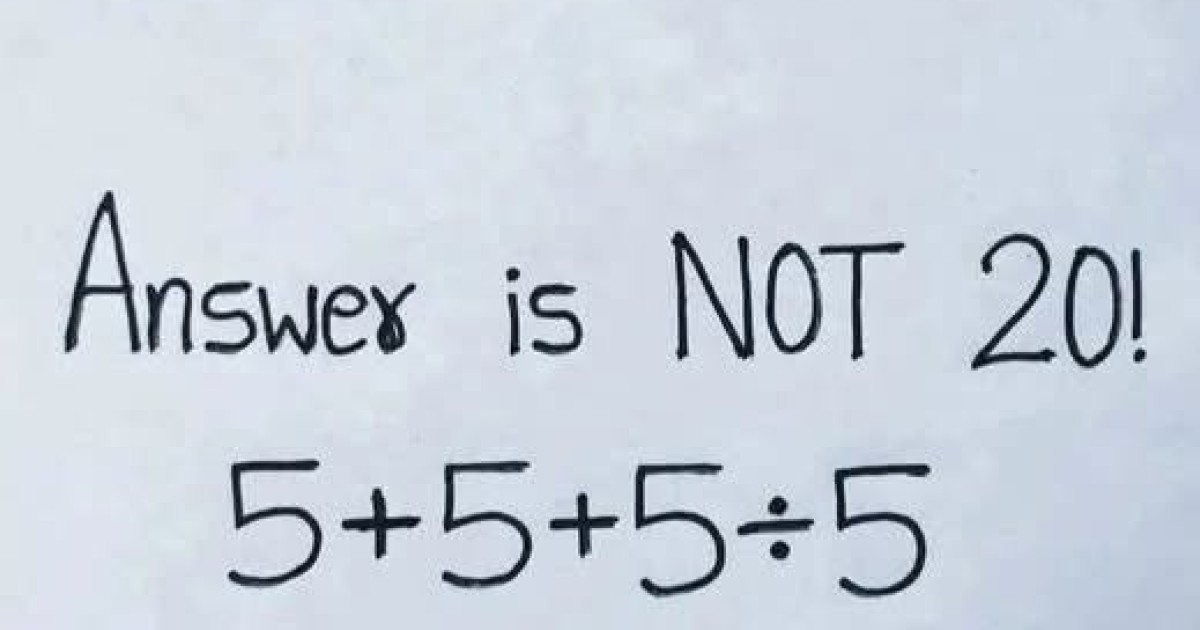
Math puzzles often challenge our logical thinking and problem-solving abilities. One such intriguing puzzle presents a seemingly simple arithmetic expression that can easily trip up the unprepared mind. In this article, we will explore the expression 5 + 5 + 5 ÷ 5 and reveal how to arrive at the correct answer by adhering to the fundamental order of operations.
Understanding the Order of Operations
To solve mathematical expressions accurately, it’s crucial to follow the correct sequence of operations, commonly remembered by the acronym PEMDAS, which stands for:
- Parentheses
- Exponents
- Multiplication and Division (from left to right)
- Addition and Subtraction (from left to right)
The order of operations dictates that division and multiplication should be carried out before addition and subtraction unless there are parentheses that indicate otherwise. This rule is essential in ensuring consistent results in mathematical calculations.
Breaking Down the Expression 5 + 5 + 5 ÷ 5
Step 1: Perform the Division First
In our expression 5 + 5 + 5 ÷ 5, the first operation we address is the division:
- 5 ÷ 5 = 1
Now, we can rewrite the expression, inserting this result:
- 5 + 5 + 1
Step 2: Perform the Addition
With the division completed, it’s time to tackle the addition:
- First, we add the first two numbers: 5 + 5 = 10
- Next, we take this result and add the value from the division: 10 + 1 = 11
Thus, the final result of the expression is 11. This emphasizes the importance of adhering to the order of operations.
The Trick: Common Misunderstandings in Arithmetic
Many individuals attempt to calculate the expression without following the order of operations, which leads them to an incorrect total. The trick in this puzzle is to add the numbers before performing the division, thus misleading one to think:
- First addition: 5 + 5 = 10
- Second addition with the remaining five: 10 + 5 = 15
This mistake is a common cognitive trap, reminding us how important it is to apply mathematical principles correctly to avoid errors.
Why Solving Math Puzzles Is Beneficial
Engaging with math puzzles like this enhances critical thinking and develops problem-solving skills. Here are some benefits of regularly solving math challenges:
- Boosts cognitive skills: Regular practice sharpens mental agility and improves reasoning abilities.
- Enhances focus: Solving puzzles requires concentration, promoting improved attention to detail.
- Builds confidence: Successfully navigating mathematical challenges fosters a stronger sense of self-efficacy.
- Encourages a positive math mindset: Overcoming challenging problems helps to reduce math anxiety and instills a more favorable attitude towards mathematics.
Incorporating Math Puzzles into Your Life
Whether you are a student trying to master math concepts, a teacher looking to engage your students, or simply someone who enjoys numbers, introducing math puzzles into your routine can be incredibly rewarding. Here are several ways to incorporate them into your life:
- Practice regularly: Set aside time each week to tackle math puzzles or challenges.
- Use apps and websites: Many mobile applications and online platforms offer a variety of math puzzles tailored to different skill levels.
- Join a math club: Engaging with others interested in math can promote collaborative problem-solving and social interaction.
- Incorporate puzzles into lessons: If you’re an educator, consider using math puzzles as a teaching tool to encourage student engagement and learning.
Conclusion: Embracing the Challenge of Math Puzzles
Math puzzles like 5 + 5 + 5 ÷ 5 serve as an excellent reminder of why we must always respect the order of operations in arithmetic. By understanding the correct procedures, we can enhance our mathematical ability and train our brains to think critically. Remember, embracing challenges in mathematics doesn’t just improve our skills; it also makes learning more enjoyable.
Next time you encounter a math puzzle, take a moment to consider the order of operations and see if you can solve it without falling for the trick! Happy puzzling!
