
Understanding the Brain Teaser: Which Glass Holds the Most Water?
Brain teasers have long captivated minds, serving not only as enjoyable activities but also as tests of observation and critical thinking skills. Among the myriad of puzzles circulating on social media, one particular brain teaser poses a seemingly simple question: “Which glass holds the most water?” This puzzle, despite its straightforward appearance, reveals fascinating insights into our cognitive processes and understanding of basic scientific principles.
The Setup of the Water Glass Puzzle
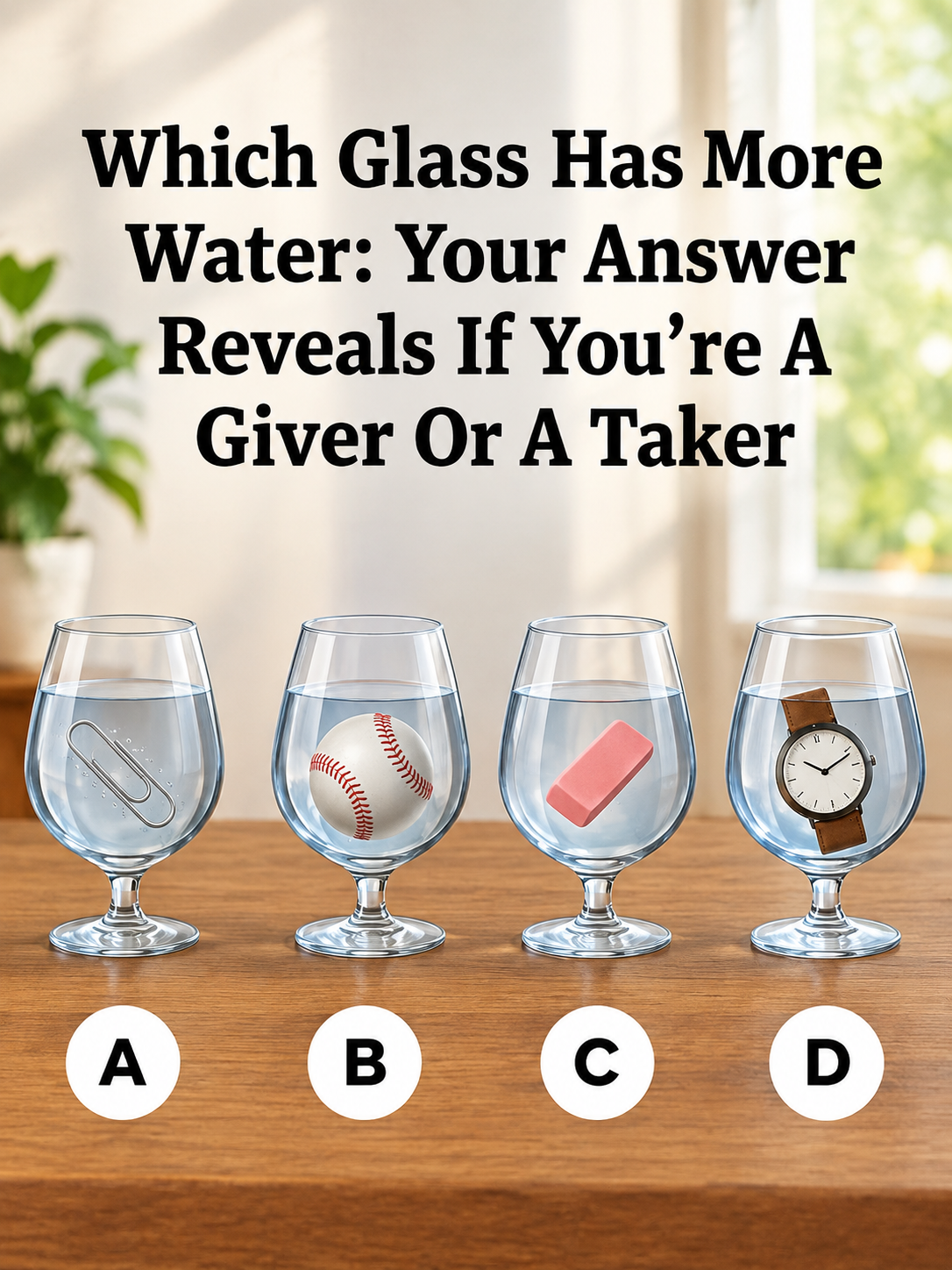
At the core of this puzzle are four identical glasses, labeled A, B, C, and D. Each glass appears to have similar water levels, and at first glance, one might assume they each hold the same amount of water. However, this is where the fun begins. Each glass contains a different object:
- Glass A: A paperclip
- Glass B: A baseball
- Glass C: An eraser
- Glass D: A wristwatch
The central question is which of these glasses contains the most actual water. While it may seem that the water levels are equal, the sizes of the objects inside significantly affect the volume of water each glass can hold.
The Science Behind the Teaser: Water Displacement
The key to understanding this puzzle lies in the scientific principle of water displacement. According to this principle, when an object is submerged in water, it displaces an amount of water equal to its own volume. Thus, the size of each object plays a crucial role in determining how much actual water remains in each glass.
How Water Displacement Works
To grasp the concept fully, consider the four objects in the glasses:
- The paperclip in Glass A has a small volume, causing minimal water displacement.
- The baseball in Glass B occupies a significantly larger volume, thus displacing more water.
- The eraser in Glass C also takes up more space than the paperclip but less than the baseball.
- The wristwatch in Glass D, while not as bulky as the baseball, still displaces a notable amount of water.
When determining which glass holds the most water, one must consider the volume of the objects submerged in the water. The glass with the object that occupies the least volume will inherently have more water than the others.
The Correct Answer: Glass A
Upon careful examination, the answer to the puzzle becomes clear: Glass A contains the most actual water. The small volume of the paperclip means it displaces the least amount of water, allowing for a greater volume of water to remain in the glass. In contrast, Glass B, with its baseball, holds significantly less water due to the larger displacement from the baseball. Similarly, Glasses C and D, containing the eraser and wristwatch respectively, also have less water than Glass A.
Why the Puzzle Trick Us
This brain teaser is particularly tricky because our brains tend to focus primarily on the visible aspects of a problem—here, the water levels in each glass. We often overlook the crucial role that the submerged objects play in determining how much water is actually present. This cognitive bias highlights the necessity of careful observation and the importance of questioning our first impressions.
Cognitive Bias and First Impressions
Humans have an innate tendency to rely on first impressions. In the context of this brain teaser, our initial reaction is to judge the glasses based solely on the visible water level. When faced with a situation where visual cues are misleading, it serves as a reminder to dig deeper into the details rather than settle for the surface-level conclusion.
More Than Just a Puzzle: The Psychological Insights
Some versions of this puzzle go beyond mere observation challenges, suggesting that your answer could reveal deeper insights into your personality traits. While these claims make for interesting discussions, they are largely anecdotal and not supported by rigorous scientific research. The puzzle is best appreciated as a mental exercise, encouraging logical thinking rather than as a definitive personality test.
The Giver vs. Taker Theory
One popular theory suggests that the glass a person chooses reflects whether they are a “giver” or a “taker.” According to this idea, individuals who select Glass A might be seen as nurturing and generous, while those who choose Glass B or C are labeled differently. However, it’s essential to approach such claims with skepticism, as they lack empirical evidence.
The Educational Value of Brain Teasers
Brain teasers like this one serve a dual purpose. They entertain and challenge our intellect while also functioning as tools for education. Engaging with puzzles enhances critical thinking skills, problem-solving abilities, and observation techniques. Furthermore, they encourage a mindset that values meticulousness and analytical reasoning.
The Takeaway: Lessons from the Glass Puzzle
This brain teaser teaches an important lesson: appearances can be deceiving. Just because two things look alike does not necessarily mean they are the same. This puzzle reminds us of the importance of understanding the underlying principles at play in our everyday experiences. Did you identify Glass A immediately, or did the challenge prompt a second look? Your experience with this brain teaser may serve as a valuable lesson in both observation and reasoning.
As we continue to engage with various puzzles and challenges, we strengthen our cognitive skills and learn to look beyond the obvious. Whether it’s in daily life or academic pursuits, the ability to analyze and question what we see can lead to remarkable insights and improved decision-making.
