
Arthur broke off another corner of his buttermilk biscuit and tapped it against the edge of the diner booth. A large white duck sat right there on the green vinyl, its yellow bill clicking against the plate as it swallowed.
“The health inspector comes in at eight-thirty, Arthur,” I said.
I took a slow sip of my coffee, which still cost two dollars at the register but tasted mostly of paper cups and tap water. Arthur did not look up, but he tipped his faded canvas cap toward me.
“She is a tidy girl, Robert,” Arthur said, with a cheerful, deliberate whistle between his words. “She has her own napkin.”
I looked at the cuffs of Arthur’s flannel shirt. They were frayed to the blue threads, hanging loose around wrists that looked much thinner than they had when he still worked the south acreage.
He pulled a silver pocket watch from his vest, the old case dull from years of pocket lint. It was the one his wife, Sarah, had bought him for their thirtieth wedding anniversary, back when the farm was still sending three trucks of corn to the county line every autumn.
“The town council has an ordinance about livestock indoors,” I said. “Even clean ones.”
“Ordinances are for people with too much pavement,” Arthur whispered.
He slid the watch back into his pocket, his hand lingering on the worn fabric. A quiet sort of gray shadow passed over his face, the kind I had been seeing more often since the funeral last spring.
The lemon wax smell in the station lobby always got stronger by mid-morning when the sun hit the front windows. David, our new deputy, was standing by the high counter with a blue clipboard in his hand.
“We have a code four-twelve in progress on Main Street, Officer,” David said, his voice loud enough to rattle the mailboxes across the street. He gripped his heavy leather utility belt and pulled it up an inch.
“Speak English, David,” I said, rubbing my left shoulder. It had been stiff since the rain on Tuesday.
“Arthur Boyd has a domestic water bird unsecured on public property,” David said. “I have the citation drafted. We just need your signature to log it into the county system.”
“He was feeding it a biscuit,” I said.
“The code says municipal spaces must remain clear of agricultural interference,” David said, his fingers tapping against his clipboard. “If we let one slide, the whole square becomes a pasture.”
“Leave the clipboard on my desk,” I said. “I will look at it when the sun goes down.”
David frowned, his jaw tightening as he adjusted his belt again. He did not leave the clipboard.
At one o’clock, the heat had softened the asphalt along the curb of the square, leaving it sticky under my boots. Chief Victor was standing near the bandstand, tapping his gold wedding band against the wooden railing while he looked at a diagram of folding chairs.
“We need sixty chairs on the left and forty on the right,” Victor said, his booming voice carrying across the empty lawn. “Clara wants a simple path down the middle, but her mother thinks we need a wide lane for the dress.”
“Arthur Boyd is losing weight, Victor,” I said.
Victor did not look up from his diagram. “We all lose weight when the humidity climbs. Did you talk to the florist about the delivery truck parking?”
“He was in the diner with a duck on the seat next to him,” I said. “His sleeves are coming apart at the wrists.”
“Arthur is seventy-four years old,” Victor said, tapping his ring twice against the wood. “He has earned the right to be a little strange. Just make sure the street is clear for the wedding cars on Saturday.”
He turned the paper sideways, already walking toward the church steps without waiting for me to answer.
The road out to Arthur’s place was five miles of dry gravel that left a thick layer of gray dust on my patrol car’s windshield. When I pulled into the driveway, the old green pickup was idling near the barn, its exhaust pipe coughing a thin blue smoke.
Arthur was standing by the tailgate, lifting a heavy wooden crate into the truck bed. Around his boots, dozens of white ducks were milling in the dirt, their feathers pure white against the dark soil.
“You are doing some heavy lifting for a Tuesday afternoon,” I said, getting out of the car.
“They need a ride, Robert,” Arthur said. He tipped his canvas cap, his face flushed red from the heat.
I looked toward the porch of the farmhouse. A stack of white envelopes was piled near the screen door, some of them yellowed from the morning damp, sitting unopened on the wooden steps.
“The mailman has been busy,” I said.
“Just flyers,” Arthur said, whistling between his teeth as he hoisted another crate. “Nothing that needs a reply.”
“You cannot keep running this place alone, Arthur,” I said, looking at the overgrown grass along the fence line. “It is too much acreage for one man.”
Arthur stopped, his hand resting on the dusty green side of his truck bed. He looked toward the empty barn, then back at me.
“We all have to find a way to keep moving, Robert,” he said.
He climbed into the cab and pulled the door shut with a heavy metallic clang.
I watched the green pickup roll down the driveway, the back filled with white feathers and the steady, rhythmic sound of forty ducks quacking into the hot afternoon air.
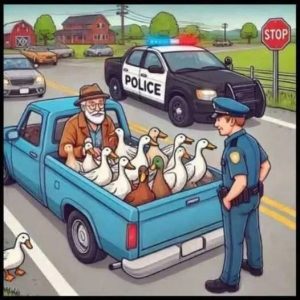
I pulled the cruiser across the double yellow line of Main Street at two in the afternoon, blocking the lane just enough to make the green pickup halt. The late August heat was cooking the street, making the asphalt soft under my boots as I stepped out.
Arthur sat behind the wheel, his faded canvas cap tipped low against the sun. In the truck bed behind him, dozens of white ducks were shifting, their feathers bright against a large, hand-carved wooden crate made of weathered oak.
“You are causing a bottleneck, Arthur,” I said, leaning my arm on his hot door frame. “The chief is already nervous about the wedding traffic this weekend.”
Arthur gave a cheerful whistle between his teeth, his fingers tapping the steering wheel. “The road is wide enough for all of us, Robert.”
“Where are you going with a mobile aviary?” I asked, looking back at the wooden duck crate. “You cannot just parade them through the business district.”
“They look like they want to see some penguins, officer,” Arthur said, his eyes crinkling at the corners. “I promised them a trip to the zoo.”
I rubbed my left shoulder, the old joint aching from the humidity. “The nearest zoo is sixty miles away in Toledo, Arthur.”
“Then we had best get moving before the gates close,” he said, shifting the truck into gear with a dry grin.
He pulled away before I could answer, leaving a faint smell of river mud and dry straw in the hot air.
At half past three, David was riding shotgun in my patrol car, his fingers constantly adjusting his heavy-duty utility belt. He was speaking fast, reciting the municipal codes for transporting live cargo on public roads.
“We should have cited him,” David said, his voice loud in the cramped cabin. “The rules apply to everyone, Robert, even the retired ones.”
He bent down to adjust his boot lace and spotted a crumpled sheet of legal paper wedged between the passenger seat and the center console. It must have fallen from Arthur’s pocket when he leaned into the car earlier.
David smoothed the paper over his knee, his eyes scanning the typed lines. “What is this?”
I glanced over and saw the heading of a standard county land deed. It was a transfer of ownership for Arthur’s back pasture, the twenty-acre parcel that bordered the creek.
“Let me see that,” I said, reaching over to take the paper from his hand.
“Is he selling off his property?” David asked, his pen already hovering over his notepad.
I did not answer him, pocketing the document instead.
I walked into the town hall at half past four, the cool air inside smelling of lemon wax and old paper. Martha, the county clerk, sat behind the counter, her glasses hanging from a silver chain around her neck.
